

Angelica Sanchez: Epazote, Oregano, Tomatillo and the 'Mother of All Chiles'


Tell us a little about your family’s story.
Angelica Sanchez: I’m first generation across a number of different spaces. My family came from Mexico to the United States in search of work. My grandfather first came to the United States, and the rest of the family joined him in 1990. I grew up in a full house of aunts and uncles. We settled in Nogales, because it created a bridge between the members of my family that were documented, and those that were not. We could still spend holidays together in Mexico, without having to travel too far.
You are growing chiltepin in honor of the decades old plant she has in Nogales. What is your grandmother like? Do you have any favorite anecdotes or memories with her?
Angelica Sanchez: My grandmother is an incredibly strong woman. Have you ever heard of Paquita del Barrio? She was affectionately known as Paquita by her friends. She had a stand at a swap meet, where she sold used goods. I would hear folks refer to me as “Paquita’s nieta” as I walked around the space. She looks so much like her, people often stopped her and asked for her autograph. My favorite instance of this took place at a stop light in Mexico. The person who was performing a fire-spitting act saw her and began exclaiming that Paquita was here. My grandmother rolled down her window and began waving at everyone around us, while they all cheered. I asked her why she didn’t tell them it wasn’t her, and she said that it made them happy. She said that at first, she would tell people that she wasn’t Paquita, but that people would then become angry at her. They would become argumentative, and would tell her not to lie. She said it was just easier to let people believe what they wanted. She always signed whatever folks gave her, even though she always warned them not to try to sell it because she wasn’t Paquita.
What was it like growing the tomatillos, chiltepin, epazote, and oregano at McAllister Ranch? Have you grown them before?
Chiltepin was always a staple in everyone’s kitchens. When I moved away, I stopped eating it because it was hard to find. I wanted to grow it so that I could have a little piece of home with me! I’ve never grown it before, but my grandmother had a decades old plant, and my mom has one in her backyard as well! First, we dry them out. A little bit goes a long way, and you may not even need a whole pepper to spice up your dish. My family likes to eat them in caldos, which generally refers to dishes with broth in them. My favorites are caldo de queso and albondigas! Albondigas is the first dish I learned how to cook.

It’s absolutely imperative that you use a chiltepin grinder. If you crush a chiltepin in a regular old mortar and pestle, you’ll be in for a spicy surprise next time you use it! Chiltepin crushers look a bit different from a usual spice grinder. They are cylindrical with an opening just big enough for a couple of peppers. The stem is then pushed into the crusher to grind one or two peppers. You can then pour it out directly into your bowl!
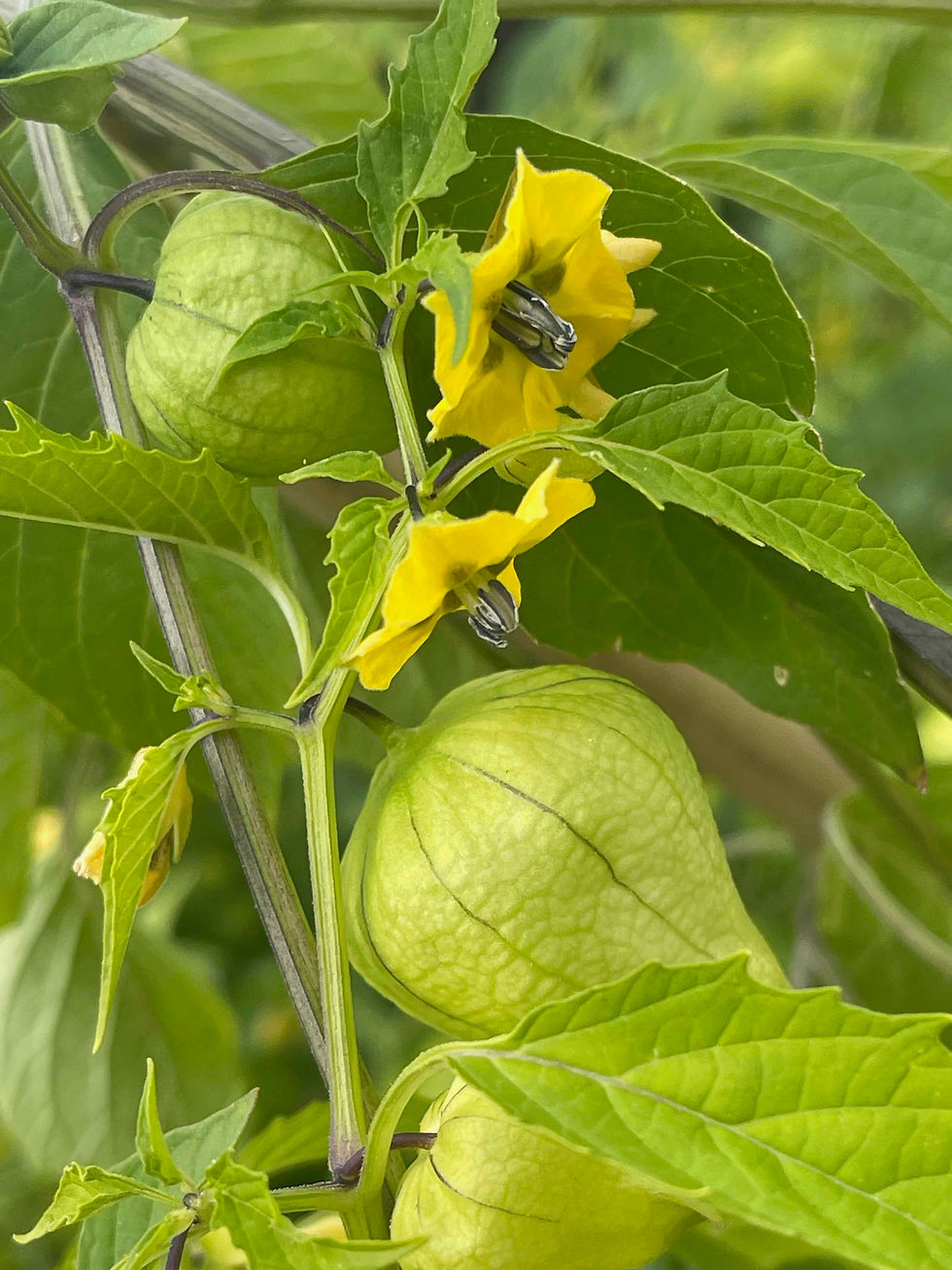
I absolutely love growing tomatillos! They look so whimsical as they grow in their little lanterns. I love the way they look in my backyard. I have grown them before, but it was completely different to grow them at McAllister. The growth was unbelievable. I knew they were prolific, but at home, I was able to contain them fairly easily. I used tomato cages and usually grew them in a 7 gallon pot. My plan had been to use stakes as they started off, while also using a Florida Weave method. They exploded before I was able to act on my plan.
My family mainly uses tomatillos for green salsa bases. Making a green salsa base means that you can use it in a number of dishes! It can definitely be used as a starter for table salsa, but we enjoy cooking with it. My favorite is a green chile pork dish. An easy way to use it is to put some salsa in a crock pot with chicken thighs and chicken stock. After a few hours, you can shred the chicken and toss it in the crock pot contents. You can use the chicken to make tacos, taquitos, burritos, chimichangas, or gorditas!
I’ve grown epazote before, but this was my first time growing red epazote. The leaves are a gorgeous red hue, and has jagged edges, similar to arugula. It’s a delicious and potent herb. My family usually uses it in bean dishes, to remove gas, assist digestion, and add a depth of flavor. It can have anise-like taste. Too much can be dangerous; however, a dish becomes unpalatable when too much is added. Trust your taste buds! One of my favorite things about epazote are its Mexican roots. Epazote comes from the Nahuatl epatli and zotli, which means skunk herb. The herb also has medical properties. Epazote tea can help treat intestinal parasites.
I love growing Oregano, especially because it’s a perennial! I love plants that come back year after year to season your meals. It pulls double duty by having cute light yellow flowers that draw in the pollinators. In my family’s cooking, it ranks amongst the essentials, on a similar level as salt and pepper. Oregano’s versatility makes it a vital kitchen staple. It also has medicinal properties. Oregano can be used to support respiratory functioning and digestive health. It also has antimicrobial properties.

A recipe:
Green Cooking Salsa Base
A jar of salsa could always be found in my home. We usually made a salsa base that could then be adjusted to whatever it was we were making. It could serve as an appetizer or it could be used in cooking. My moms favorite salsa is called Salsa Frita. It is made with the same ingredients below, but the tool is different. A large disc is set over a flame with oil. All of the ingredients are fried and constantly stirred. It adds a layer of flavor to the salsa, but unfortunately, we don’t all have access to a large frying disc!
The beauty of salsa is that it can be tailored to your personal taste buds, or what you have on hand. The ratio of peppers to tomatillos is completely up to you. My go to is 3 tomatillos to 1 pepper ratio, but if the peppers are spicy, I might adjust this! Measurements are also difficult to address. Unlike baking, cooking is not quite an exact science. There may be times when a teaspoon of salt is perfect, and there may be times when it is too much or too little! Please note that the measurements below are a guide, but taste often. You can always add more later, but once added, cannot be removed with ease! You can substitute tomatillos for any kind of tomato, and you can use any chile you might have on hand.
Ingredients:
Vegetable oil (or any kind of frying oil)
9 Tomatillos
3 Jalapeño Peppers
Half of a large brown onion
4 cloves of garlic
A handful of Cilantro
A few sprigs of Oregano
A teaspoon of salt
A teaspoon of black pepper
Chicken Stock, as needed, or Vegetable Stock
Tools:
A large metal baking tray
A molcajete or a blender
A cutting board
A knife
Preparing the vegetables:
Preheat the oven 400℉
Remove the tomatillo husks and wash the fruit.
Remove the stem of the jalapeños and rinse the vegetable
*If you prefer less spicy salsa, take a moment and remove the seeds as well.
Remove the skin of the onion and cut half an onion into 6 even pieces
Peel 4 cloves of garlic and crush it with the back of your knife
Toss the tomatillos, jalapeño, onion and garlic in oil and place it on the baking sheet
Put the baking sheet in the oven. Checking on it frequently, and tossing the vegetables to ensure they receive an even char. This might depend on the amount of moisture in your vegetables, but this process normally takes about 10 - 15 minutes.
Once all of the vegetables are soft, and they have a lovely color about them, remove them from the oven to cool.
Making the salsa:
Add your roasted vegetables, including any juices, and the rest of the ingredients (except for the chicken stock) to the blender or molcajete.
Use the pulse feature on your blend to begin to blend the ingredients. Use the mano to begin crushing the ingredients in your molcajete.
Take stock of what the salsa texture is. Add chicken stock depending on your preference for a chunky or watery salsa. Consider what you will be using it for when making this decision.


Comments